- how many of your workflows one system covers
- whether e-invoices move through an operator automatically
- whether bank statements arrive over a connection, not as a file
- whether VAT and payroll tax returns are produced and filed from the program
- whether data can be migrated from your current program
- and only then: the monthly plan and how the price grows
Best accounting software 2026: an honest comparison for Estonia.
For a small business in Estonia, the best accounting software is the one that covers all of your workflows in one system and meets Estonian obligations without intermediate files; there is no single winner for everyone. Judge it by six criteria: how many of your workflows (sales and purchase invoices, payroll, inventory, point of sale) one program covers, whether bank statements arrive over a connection, whether e-invoices move through an operator, whether the VAT return (KMD) and the payroll tax return (TSD) reach the Estonian Tax and Customs Board straight from the program, whether your data can be moved over from your current program, and what the price will be as the company grows. A sole trader, a three-person trading company and a housing association weigh these criteria differently, so the better question is which program covers your own workflows without a second system. This guide lists the Estonian market options as of 2026, the criteria for choosing accounting software and a test to run before deciding, and is honest about where Saldofy itself stands today.
To see Saldofy as a whole, start from the home page, which brings together accounting software, inventory, manufacturing and POS.
Short answer.
The best accounting software is the one that covers all of your workflows in a single system and handles the Estonia-specific integrations (e-invoices, bank connections, tax authority filings) without intermediate files. In 2026 the widest user base on the Estonian market belongs to Merit Aktiva, the simplest option for a small company is SimplBooks, Directo reaches furthest toward ERP, and Erply is strongest in retail. Saldofy is the newcomer among them, and its differentiator is the breadth of modules inside one platform.
1. Why best depends on your company profile.
Most comparisons rank programs by price, but the real cost appears elsewhere: where one system fails to cover a workflow and a second program has to be added. Two tools mean moving data by hand, reconciling at month end and maintaining two contracts.
So the only practical way to evaluate is to write down your workflows (sales invoices, purchase invoices, payroll, inventory, point of sale, tax returns) and count how many of them a single program covers. Only then look at the price.

2. The Estonian market options in 2026.
The list below describes what each option is known for on the market. Prices and features change, so always check the vendor's own price list before deciding.
A comparison of Saldofy with Merit Aktiva, SimplBooks, SmartAccounts, RIK e-arveldaja and Erply, with sources and check dates, is on the accounting software comparison pages.
- Merit Aktiva: Estonian-built, widely used by accountants and accounting firms; a strong choice if your accountant already uses it
- SimplBooks: Estonian-built, focused on simplicity; suits a small company doing its own bookkeeping
- Directo: an ERP-leaning solution for medium and larger companies with inventory, projects and multiple units
- Erply: strong in retail, where the point of sale and inventory are the core of the business
- e-Arveldaja (RIK): the state-provided option for micro companies and sole traders with a handful of invoices a month; as of 10 November 2026 free for the first 12 months, then a small fee based on the number of entries
- Saldofy: the newcomer, differentiated by module breadth; accounting, payroll, inventory, point of sale, housing associations, forestry and manufacturing inside one platform
3. Who each option suits.
If you have to choose without a long evaluation, the split below covers most cases.
- Sole trader or micro company with a few invoices a month: the state e-Arveldaja may be enough (free for the first 12 months, then a small fee based on the number of entries)
- Small company doing its own bookkeeping: SimplBooks or the Saldofy free plan
- Company whose accountant works at a firm: ask first what the firm uses
- Retail, where the till and inventory are the core: Erply, or Saldofy if you want the point of sale and accounting in one system
- Inventory, projects, multiple units: Directo
- Housing association: choose a specialised solution; in Saldofy the housing module sits inside the same accounting
- Forestry or manufacturing: choose a solution where purchase acts or work orders post straight into accounting, not a separate program
4. Where Saldofy stands in 2026: the honest picture.
Saldofy reached the market in 2026. That means we do not claim to be the best accounting software of 2026: Merit Aktiva and SimplBooks have years of user base, established habits inside accounting firms and a partner network that a new product does not build in a year.
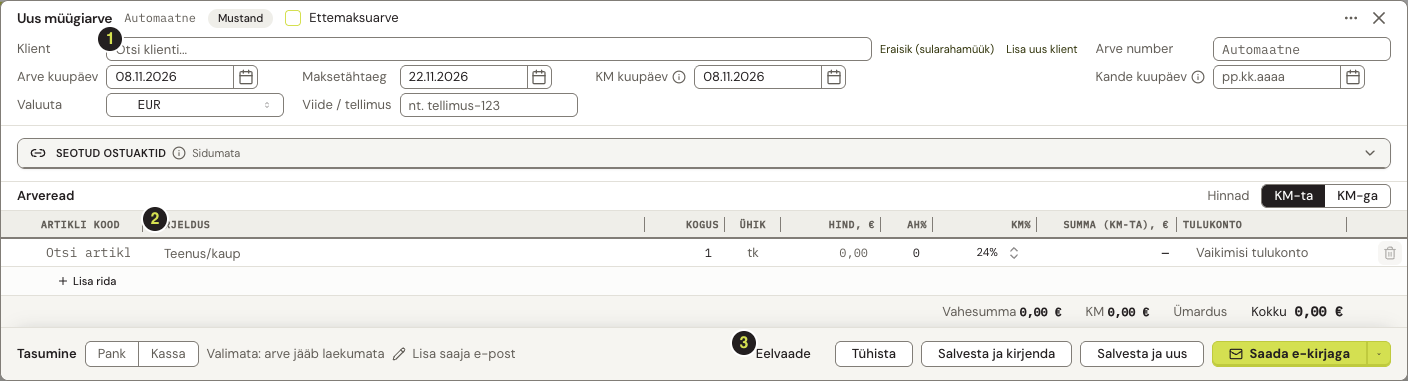
What Saldofy genuinely has in 2026: sales and purchase invoices, payroll, inventory, bank connections, e-invoices through an operator, VAT and payroll tax filing to the Estonian Tax and Customs Board, the annual report, and on top of that modules a normal accounting program does not include: a point of sale system, housing association management, timber purchase acts and manufacturing. All on the same data, with no integrations between the modules.
The honest counterpoint: if your accountant has worked in one program for years and your company has only classic accounting needs, there is no strong reason to switch. Saldofy is worth considering when you are running several programs at once, or have a workflow your current system does not cover.
5. Why we are aiming at 2027.
Our goal is to be the best choice for an Estonian company by 2027. A claim like that should not be made without criteria someone can check it against, so here are the criteria to judge us by.
If any of them does not hold a year from now, that is our failure, not the market's.
- every module under one price list and one dataset, with no add-on integrations
- data migration from Merit Aktiva and SmartAccounts without manual retyping
- VAT and payroll tax returns filed to the tax authority straight from the program
- e-invoices moving both ways through an operator and the Peppol network
- a permanent free plan for a starting company, not just a trial
6. Choosing accounting software: measure manual work, not feature counts.
Accounting software keeps track of a company's sales, purchases, pay and taxes and produces the returns and reports the law requires. On paper most feature lists look alike. What separates the options is how much manual work is left after you go live: how often you retype the same amount somewhere else each month, how often you export a file from one program into another, and how long month-end reconciliation takes.
The second question is the price as the company grows. Check what happens when you add an employee, a second company, a warehouse or a till: is it inside the same plan, a separate module or another program altogether? A predictable price means you know the answer before you sign.
- write down how many times a month you move data by hand from one place to another
- ask whether a sales invoice, a bank line and the journal entry are linked automatically or by hand
- check whether a tax return comes from the same data or from a separate export file
- work out the price for the next two years of growth, not only for today's volume
7. Separate inventory and POS programs, or one platform?
When sales, inventory and the point of sale live in separate programs, data has to be brought into accounting by hand or through export files, and the differences surface at month end. One platform, where the sales invoice, the stock movement and the till receipt post straight into accounting, cuts both manual work and reconciliation.
In Saldofy, inventory, the point of sale system and accounting use the same data. The point of sale system is a separate paid package and extra tills cost extra; packages and prices are on the price list.
8. Which integrations does your company need?
Assess e-invoicing, bank connections and tax authority (EMTA) filing against what your business actually does. A direct bank or X-tee connection is not a general legal requirement for every company, but it saves time every month.
E-invoice requirements depend on the transaction and the recipient: a buyer registered in the Business Register as an e-invoice recipient can require an e-invoice from the seller. According to the Ministry of Finance, the earlier public sector e-invoice obligation was replaced in 2025 by the buyer's right to choose the format in which it receives invoices. The current conditions are in the Ministry of Finance guidance.
- e-invoices: does the program send and receive them through an operator, and is that included in the plan
- bank: does the statement arrive over a connection or as a file, and how are lines matched to invoices
- EMTA: are the VAT return (KMD) and the payroll tax return (TSD) produced in the program, and how do they reach EMTA
- Business Register: how is the annual report prepared, and what is left to do in the e-Business Register
9. How to decide for yourself: a two-week test.
No comparison article, this one included, replaces testing with your own data. Two weeks is enough if you test with real documents rather than sample data.
In Saldofy, start on the permanent Free plan or try the full scope of a paid plan during its trial. The Free plan covers one company per account and a small monthly invoice volume; the exact limits are on the price list. Run the test before you move your data and processes into a new system.
- enter one real sales invoice, check its VAT and journal entry, and send it out as an e-invoice
- import one real bank statement and see how many lines match automatically
- calculate one real month of VAT and check the figures trace back to source documents
- run pay for one employee, compare the result to your current program to the cent and look at the TSD output
- try importing your data from the current program before signing anything
Frequently asked questions.
Cloud software or a program installed on a computer? Web-based (cloud) software needs no installation or own server and works from any device. An installed program ties the work to one computer. Saldofy runs in the browser.
Can I manage several companies from one account? For an accountant, or an owner with several companies, it matters that one account can manage several companies with separate permissions. The Saldofy Free plan has one company per account; managing several companies is part of the paid plans.
How do I move data from my old software? A good migration flow brings over the chart of accounts, opening balances and open invoices without retyping. In Saldofy you choose a start date (alguskuupäev) from which the books are kept; data from Merit Aktiva and SmartAccounts comes over with an API key, and from other programs with an Excel template.
Sources and further reading
Related product views.
Accounting software where entries come from invoices and the bankAccounting software for small business in Estonia: invoices, taxes and reports in one placeBusiness management software where accounting, inventory, POS and manufacturing are one systemAccounting software for accounting firms: each client as its own companyAutomated accounting: what the software does on its own and what you checkFree accounting software with a permanent plan, not just a trial

More guides.
Test Saldofy with your own real data.
The Saldofy free plan is permanent, not a trial: you can test it with your real invoices, bank statement and VAT before deciding anything.